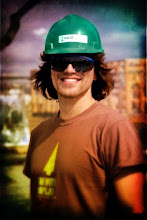
All Americans, although reluctantly, agree that the British accent is better in nearly every way. A British person who comes to the States is generally lauded for his cutting wit and inexhaustible charm, and a Brit will always have the upper hand on an American in wooing the ladies, despite how crooked his teeth may be. We may joke at how they call a “flashlight” a “torch” and the funny way they say “herb” by distinctly pronouncing the “h”, but there is no doubt the American accent is inferior.
Kenya was a British colony for a long time, and has therefore been subjected to the British way of speaking. But because English tends to be taught as a third language to many Kenyans, it becomes incorrigibly altered and twisted in the most interesting ways.
A few examples of this interesting fusion: In Mombasa there is a place called “Marikiti” pronounced “Mar-ee-key-tee.” It is a place where many people come to sell their produce and their goods. Only later did I find out that the name is actually supposed to be “Market” but it was just spoken in a Swahili accent, and the name stuck. As another example, I was looking over the attendance list of a woman's group, where each woman was required to write their name and sign. Some of these women have not had much schooling, and one particular lady named “Caroline” wrote her name as “Rarolini” or “Ra-row-lee-nee.” Because people pronounce her name “Rarolini,” she wrote her name as she thought it to be spelled. It sounded more like a type of pasta than a name, and I couldn't help but think it was the cutest thing ever.
Certain tribal languages in Kenya often mix and match the “L” and the “R” sounds. Kikuyu people especially have a difficult time saying words like “Large Ladders” or “Parallelogram”. But my favorite is how people call semi-trucks “Rollies.” The British term for semi's is “lorries,” but because of this L-R confusion, it comes out perhaps more appropriately as "rollies" - Those semi's do have lots of wheels.
But sometimes this dependence on phonetics becomes a barrier to communication.
I walked up to the taxi driver and I asked him in Swahili to take me to the “Leopard Lodge,” which I said in English. He looked at me as if he had no idea what I was saying. I was amazed to think he did not know of the place. Taxi drivers usually have an incredible working knowledge of their area, and I had just seen a massive sign with the “Leopard Lodge” written on it, so the place was definitely not obscure. I repeated myself, speaking very slowly this time. Still, he looked at me puzzlingly, trying to mimic the name I was saying. At last I just said the Swahili word for “Leopard” and he then looks at me with an eased expression, “Ohhhh,” he breathed. “You want the Lay-oh-pard Lodge.” I chuckled as I heard him pronounce it. I had forgotten that the Kenyan way of saying English words is to pronounce every single letter, so he could not at all make out the way I was saying it: “lep-rrd.”
The other day I asked my counterpart if she was going to watch the meteor shower at night these coming nights. It was supposed to be one of the biggest showers of the year, and it was to be visible in the southern hemisphere. My counterpart is very fluent in English, yet she still looked at me completely confused. “What am I going to look out for tonight?” she asked worriedly.
“The meteor shower!” I said again.
“What?”
“Meteor. Shower.”
“The meat, what?” She repeated, exasperated.
“Do you know what meteor is? Here let me write it down.”
I wrote it down. M-E-T-E-O-R. S-H-O...
“Ooohh. May-tay-or!” She exclaimed, as she saw the first word completely written.
“Ah, yes. May-tay-or. Sorry!” I laughed again to myself. The way we Americans pronounce meteor is more like, “meet-ear” so it is no wonder others cannot understand us.
Some other words that are unintelligible if pronounced in an American accent are: tortoise (tore-toy-see, buffalo (boo-fallow), ballet (bah-let), and any word that ends with a hard “R”: gutter, robber, roar (gut-ah, row-bah, row-ah).
We may all agree that the Spanish accent is passionate and fierce, the French accent is sexy and lyrical, and the Italian accent fantastic. But there is no other accent in the world as phonetically dependent as the Kenyan English accent. And it still beats the American accent hands down.
Thursday, November 10, 2011

Saturday, September 17, 2011
The Silence Screams
She is 14 years old. A school girl. Her 20-liter jerry-can hangs awkwardly from her back. It is too late to fetch water; the road is hard to see and the wind howls furiously. She walks briskly, staggering under the weight of the water she carries back to her house. The sun has set, the last traces of light momentarily linger on the hills and the horizon. Dusk yields itself to darkness as she trudges home. This night in particular is especially dark, as if evil itself were casting its shadow over the village and infecting the hearts of the villagers with its sinister intentions. Perhaps it was.
He creeps up silently, and without warning grabs her. His large hand holds fast to her thin arms, his rough skin feels violent against hers. His other hand forcefully muffles her surprised and horrified screams. Abrasive. Suffocating. He carries her to a nearby shack, pins her to the ground and lifts her skirt. She struggles in vain, feeling suddenly vulnerable and completely exposed. One minute passes. Two minutes. Each minute longer than the last. The darkness conceals his face, saving her from witnessing his lips quiver with contorted pleasure from each forceful, unsolicited thrust, In just minutes he finishes, fixes his trousers and disappears into the darkness. She lays there shaking, gasping for breath.
Her feelings twist and wrench inside her. Dutifully, she returns home with her jerry-can full of water, unsure of how to feel; unsure if she should scream, or shout, or swear-- unsure if she should cry. As she looks into her mother's weary eyes, her lips tremble as if longing to say, “Mother, I was raped.” but the mere thought of those words felt suddenly so shameful, so absurd. She doesn't sleep at all this night, she just lies awake shaking, recounting again and again how it happened. Thinking how she ought to have covered her legs more, worn more conservative clothing. Thinking how she should not have been walking so slowly, how her laziness was to blame. Perhaps it was her fault.
Her eyes are empty now. It is innocence that causes the spark and vibrancy in young souls; it is innocence that burgeons the wonder and excitement just to be alive. But hers are empty. Inside them only silence. He took it all from her. He stole from her the very things she had not yet known were sacred – her innocence, her dignity, her confidence, her future.
But this girl is not the only victim. Another girl, the youngest of four daughters. Her body has just begun to show the signs of woman-hood. Her three older sisters have already been victim to their very own father's lust. Now, he is after her. Her mother knows, and sternly instructs the sisters to keep family matters private. Should word get out to others in the area about the father's behavior, it will be hell to pay for them all. “Don't be with Father alone,” one of her older sisters advise. She knows her inevitable fate, that soon she will be raped by her father. But she's not sure she wants to be. Frightened, suffocating – in her own home she moves about like a thief in the night. Her father, the very person who represents protection and security for young daughters, represents for her the most frightening figure in her life.
Still another. She was three years old. Grandfather would place her on his lap, and while doing so, he would lift up his shuka and insert himself subtly into her. Her shrill screams were dismissed as the usual whine of a child. Nobody knew. Nobody understood why she would cry when they told her to go to Grampa. She was a three-year old without her virginity. Those memories seared into her mind, traumatizing her from childhood through adolescence. She bore her burden in silence.
The stories are innumerable.
With all these girls and women, the echoes of their pain linger in contrived laughter, and memories from the past stalk them like their own shadows. The fear of being shamed, the judgment from their families and peers, the view that they are no longer pure – too many reasons to keep from speaking out and opening up to others. They suffer alone with a burden that is too heavy for one person to bear.
Their silence is suffocating.
90 of 100 cases of rape are not reported. 90% of the time rapists in Kenya go free from their crime. In the goodness of all our consciences, we scream for justice. It is difficult to think of a single act more evil than rape and incest, how in just minutes rapists can take away the entire future of their victims.
My heart cries for all the girls, and it burns angrily for those who make these girls subject to their sick lust. One does not understand the sheer gravity of rape until one becomes its victim. And in these victims' eyes is a longing for help, a cry to just be understood. In their eyes they are searching furiously for normalcy, for refuge.
In their eyes, the silence screams.
He creeps up silently, and without warning grabs her. His large hand holds fast to her thin arms, his rough skin feels violent against hers. His other hand forcefully muffles her surprised and horrified screams. Abrasive. Suffocating. He carries her to a nearby shack, pins her to the ground and lifts her skirt. She struggles in vain, feeling suddenly vulnerable and completely exposed. One minute passes. Two minutes. Each minute longer than the last. The darkness conceals his face, saving her from witnessing his lips quiver with contorted pleasure from each forceful, unsolicited thrust, In just minutes he finishes, fixes his trousers and disappears into the darkness. She lays there shaking, gasping for breath.
Her feelings twist and wrench inside her. Dutifully, she returns home with her jerry-can full of water, unsure of how to feel; unsure if she should scream, or shout, or swear-- unsure if she should cry. As she looks into her mother's weary eyes, her lips tremble as if longing to say, “Mother, I was raped.” but the mere thought of those words felt suddenly so shameful, so absurd. She doesn't sleep at all this night, she just lies awake shaking, recounting again and again how it happened. Thinking how she ought to have covered her legs more, worn more conservative clothing. Thinking how she should not have been walking so slowly, how her laziness was to blame. Perhaps it was her fault.
Her eyes are empty now. It is innocence that causes the spark and vibrancy in young souls; it is innocence that burgeons the wonder and excitement just to be alive. But hers are empty. Inside them only silence. He took it all from her. He stole from her the very things she had not yet known were sacred – her innocence, her dignity, her confidence, her future.
But this girl is not the only victim. Another girl, the youngest of four daughters. Her body has just begun to show the signs of woman-hood. Her three older sisters have already been victim to their very own father's lust. Now, he is after her. Her mother knows, and sternly instructs the sisters to keep family matters private. Should word get out to others in the area about the father's behavior, it will be hell to pay for them all. “Don't be with Father alone,” one of her older sisters advise. She knows her inevitable fate, that soon she will be raped by her father. But she's not sure she wants to be. Frightened, suffocating – in her own home she moves about like a thief in the night. Her father, the very person who represents protection and security for young daughters, represents for her the most frightening figure in her life.
Still another. She was three years old. Grandfather would place her on his lap, and while doing so, he would lift up his shuka and insert himself subtly into her. Her shrill screams were dismissed as the usual whine of a child. Nobody knew. Nobody understood why she would cry when they told her to go to Grampa. She was a three-year old without her virginity. Those memories seared into her mind, traumatizing her from childhood through adolescence. She bore her burden in silence.
The stories are innumerable.
With all these girls and women, the echoes of their pain linger in contrived laughter, and memories from the past stalk them like their own shadows. The fear of being shamed, the judgment from their families and peers, the view that they are no longer pure – too many reasons to keep from speaking out and opening up to others. They suffer alone with a burden that is too heavy for one person to bear.
Their silence is suffocating.
90 of 100 cases of rape are not reported. 90% of the time rapists in Kenya go free from their crime. In the goodness of all our consciences, we scream for justice. It is difficult to think of a single act more evil than rape and incest, how in just minutes rapists can take away the entire future of their victims.
My heart cries for all the girls, and it burns angrily for those who make these girls subject to their sick lust. One does not understand the sheer gravity of rape until one becomes its victim. And in these victims' eyes is a longing for help, a cry to just be understood. In their eyes they are searching furiously for normalcy, for refuge.
In their eyes, the silence screams.
Wednesday, September 7, 2011
The Duke of Titles
During some swimming competitions, swimmers may be asked for a “bio” or “history of accomplishments” so they can be read as the swimmer's name is announced. Perhaps if someone was National Champion in a certain swimming race, it would be a perfect title to jot down on the bio. Being a swimmer, I also turned in my fair share of bios, and one of my favorite things to do was to write interesting (yet true) facts about myself which have nothing really related to swimming. For example: Ranked 1st on the Cal Men's Swim team in table tennis, or 2nd place in the county spelling bee competitions in the Second Grade.
Now that I have been in Kenya for over a year, I have broadened my repertoire of skills. Here is a list of titles I can now claim upon myself, surely many of them will be very handy on a resume.
The Dung Decipherer. Whether it be a cow, goat, chicken, elephant, camel, buffalo, monkey, dog, or human, either by size or by shape and texture I have the ability to tell which animal has taken a poo. I can even give a list of uses for many of the dungs I come across.
The Green Thumb: Even without much water, my small backyard garden is showing healthy, consistent growth of tomato and kale plants. Just being among the growing vegetables gives me a sense of accomplishment, and the first time I picked and prepared vegetables for a meal entirely from my garden, I felt more proud of myself than anyone rightfully should.
The Drip Irrigator. The benefits a farmer has by implementing a drip irrigation system are substantial: less water use, better crops, preservation of the soil. The biggest negative aspect, especially for poorer farmers, is the high costs involved. One way to get around these high costs is to assemble one yourself. And I have done that. Just a bucket, a ½ inch rubber hose, a needle, a lighter, and a few plastic plugs will water 80 crops with less than $20. Now if only there was some water to put in to the bucket...
The Charcoal Maker. A very handy trick for all the times the charcoal runs out at a barbecue. With just a 200 liter metal drum, any solid biomass, and 3 hours, some fresh charcoal will be ready for use.
The Iron Stomach. When we first arrived in Kenya, the medical team warned us never to go without treating the water and always encouraged us to soak vegetables for at least 20 minutes in chlorinated water if they are to be eaten raw. After one year and some months here, I eat raw fruits and vegetables sometimes without even rinsing them, even straight from the garden. Many people I know observe the “5-second rule” where any piece of food, if dropped on the floor, is still edible if recovered within five seconds. But I dare to extend my rule...to a few days. I feel like I could drink from a dirty puddle and come away unaffected.
The Masaai Bead Weaver. Recently, a fellow volunteer taught me how to weave bead bracelets like a Maasai, and now I am teaching anyone in my village who wants to know how to do it. I was teaching one specific group of former sex workers how to make these beads, and among their group was a Maasai woman. I grinned at the irony of teaching a Maasai the very skill they are famous for – especially because I represent the demographic that purchases these beads at extraordinary prices.
The Water Harvester: Perhaps this is more of an unhealthy complex now, but any drop of rainfall from my roof puts me all hands on deck trying to save that water as if it were my very child falling to her death. Once, it started raining when I was at work. I looked outside and saw the dark clouds extending as far as I could see, so I assumed it was raining ten kilometers down the road where I lived. I instantly dropped everything I was doing, saddled up on my bicycle and furiously pedaled home so I could put my buckets, basins, and pots out under my roof. I don't think I ever cycled home so quickly, and though both my backpack and I were thoroughly soaked, it was worth it.
The Sound Sleeper: One year has thankfully granted me immunity to the morning rooster crow. I know other volunteers live near more difficult animals (donkeys in the morning could substitute large church bells), but I soundly catch my Z's until my body naturally wakes me up – at 7:30am.
It's too bad I don't have another opportunity at those swimming bios. I would have quite a few more titles to put down.
Now that I have been in Kenya for over a year, I have broadened my repertoire of skills. Here is a list of titles I can now claim upon myself, surely many of them will be very handy on a resume.
The Dung Decipherer. Whether it be a cow, goat, chicken, elephant, camel, buffalo, monkey, dog, or human, either by size or by shape and texture I have the ability to tell which animal has taken a poo. I can even give a list of uses for many of the dungs I come across.
The Green Thumb: Even without much water, my small backyard garden is showing healthy, consistent growth of tomato and kale plants. Just being among the growing vegetables gives me a sense of accomplishment, and the first time I picked and prepared vegetables for a meal entirely from my garden, I felt more proud of myself than anyone rightfully should.
The Drip Irrigator. The benefits a farmer has by implementing a drip irrigation system are substantial: less water use, better crops, preservation of the soil. The biggest negative aspect, especially for poorer farmers, is the high costs involved. One way to get around these high costs is to assemble one yourself. And I have done that. Just a bucket, a ½ inch rubber hose, a needle, a lighter, and a few plastic plugs will water 80 crops with less than $20. Now if only there was some water to put in to the bucket...
The Charcoal Maker. A very handy trick for all the times the charcoal runs out at a barbecue. With just a 200 liter metal drum, any solid biomass, and 3 hours, some fresh charcoal will be ready for use.
The Iron Stomach. When we first arrived in Kenya, the medical team warned us never to go without treating the water and always encouraged us to soak vegetables for at least 20 minutes in chlorinated water if they are to be eaten raw. After one year and some months here, I eat raw fruits and vegetables sometimes without even rinsing them, even straight from the garden. Many people I know observe the “5-second rule” where any piece of food, if dropped on the floor, is still edible if recovered within five seconds. But I dare to extend my rule...to a few days. I feel like I could drink from a dirty puddle and come away unaffected.
The Masaai Bead Weaver. Recently, a fellow volunteer taught me how to weave bead bracelets like a Maasai, and now I am teaching anyone in my village who wants to know how to do it. I was teaching one specific group of former sex workers how to make these beads, and among their group was a Maasai woman. I grinned at the irony of teaching a Maasai the very skill they are famous for – especially because I represent the demographic that purchases these beads at extraordinary prices.
The Water Harvester: Perhaps this is more of an unhealthy complex now, but any drop of rainfall from my roof puts me all hands on deck trying to save that water as if it were my very child falling to her death. Once, it started raining when I was at work. I looked outside and saw the dark clouds extending as far as I could see, so I assumed it was raining ten kilometers down the road where I lived. I instantly dropped everything I was doing, saddled up on my bicycle and furiously pedaled home so I could put my buckets, basins, and pots out under my roof. I don't think I ever cycled home so quickly, and though both my backpack and I were thoroughly soaked, it was worth it.
The Sound Sleeper: One year has thankfully granted me immunity to the morning rooster crow. I know other volunteers live near more difficult animals (donkeys in the morning could substitute large church bells), but I soundly catch my Z's until my body naturally wakes me up – at 7:30am.
It's too bad I don't have another opportunity at those swimming bios. I would have quite a few more titles to put down.
Monday, August 22, 2011
Just Pictures (Part 2)

During the rainy season, sometimes the roads get a bit muddy for the public transportation system. As we climbed up a hill, twice we all had to get out and help push the matatu forward. Although not depicted in this picture, it was interesting watching big, well dressed mamas pushing the vehicle through the mud.

It is a bicycle pump.

A very old grandmother without teeth building a grass-thatched roof for a small hut. Her small cell-phone pouch she wears around her neck has the words "Jesus Loves You" written on it. I love this lady.

During a trash clean up project, I had the kids make art shapes out of bottle caps. Displayed here are two students proudly showing their bottle-cap elephant.

In the background of this photo are rare African Violets. Our tour guide informed us that this rare spot up in the Taita Hills is the only place in the world these precious flowers grow, so obviously I had to put my face next to them for a picture.

A Kenyan eating contest - 300ml of coke and 200 grams of bread. The winner of this contest was a woman.

Two women gathering grasses for their livestock. The women here can carry unimaginable quantities on their heads.
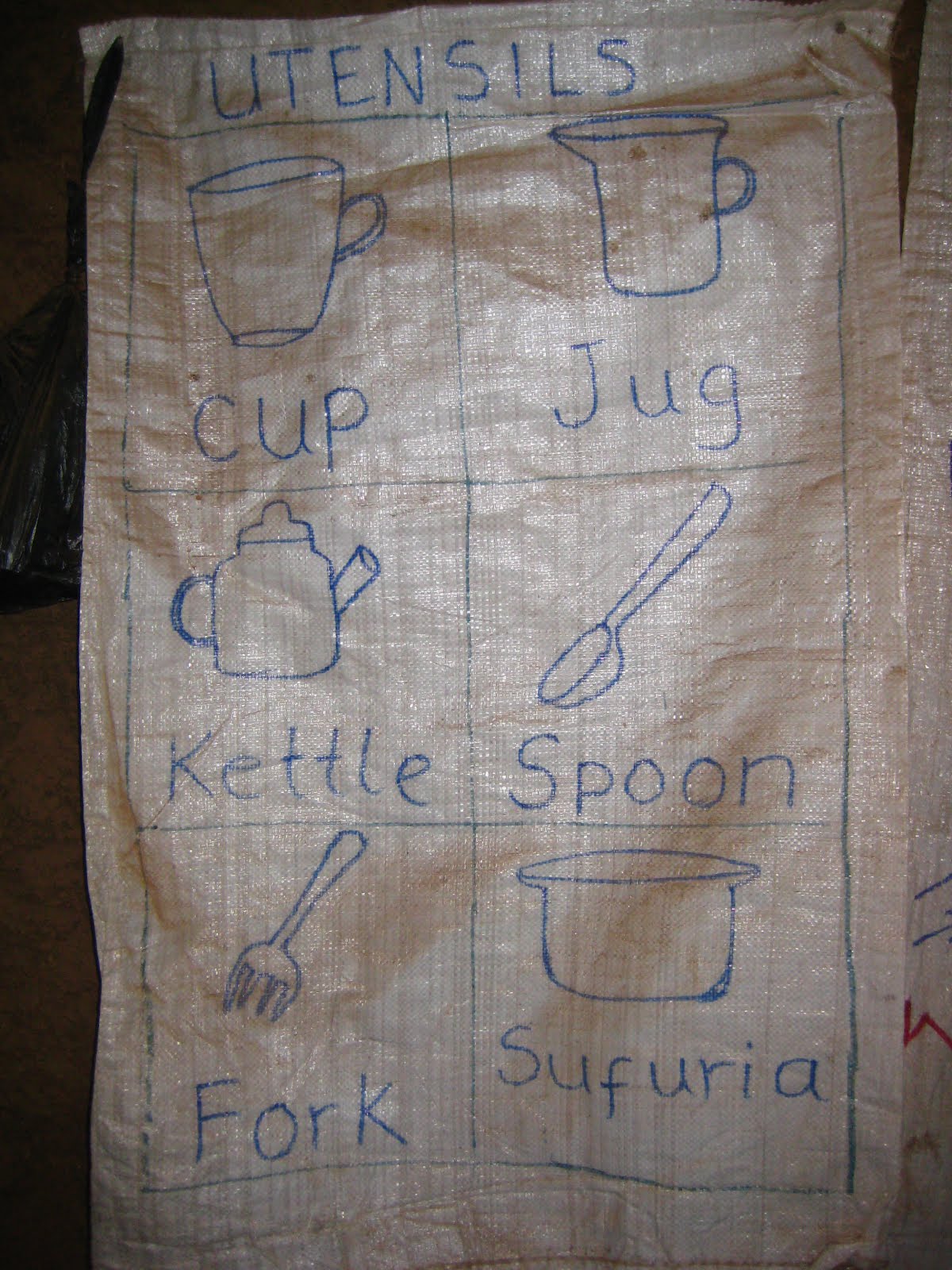
This "poster" hangs in a nursery school as a reference for the children to learn the English names of different items. Interestingly enough, the English word: "cooking pot" or "pot" was substituted for the Swahili word "Sufuria". I would think "pot" would be a little easier to learn.

This is a natural rock water catchment that stores the rain water. The small wall was built in 1961 by the inhabitants, and has served the community without fail until 2010, when a small leak was found and repaired. Now there is talk of building the wall higher and increasing its storage.

Here a teacher stands with some students during a sanitary pad making project. The teachers are always exquisitely dressed in the local patterns and fashions, and the students are always in uniform. Beautiful.
Just Pictures (Part 1)

Maasai. Beautiful. The most traditional and most displayed culture in Kenya, showcased on all travel brochures. Here they are performing a traditional maasai dance during Madaraka Day.

My evening bike ride home with the sun setting on my right shoulder. When I am late heading home, my silhouette keeps me company.

During the track/field village competitions, a student from our local school is performing the shot put.

An overturned truck seen along the Nairobi-Mombasa highway. Unfortunately this is a fairly frequent sight.

The water problem in my area. Women with their jerry cans line up behind a water truck, patiently awaiting their turn for water. These water trucks are a rare blessing, usually the people must walk miles and miles with only as much as they can carry. This truck has saved many of these women about 6 hours of walking.

Some nearly naked children playfully jump into the channel where the ferry crosses. Hopefully they don't venture too far out; sharks and other dangerous aquatic life are said to roam these waters.

The "Anti-Corruption Box" displayed on many government buildings around Kenya. Kenyans understand the biggest problem in their country is the corruption of government employees, so these "suggestion/question" boxes are an effort to keep them walking the straight line.

This is a traditional Duruma house, made with grass roofing and wooden beams and clay. A family of 9 live inside this home.

Roasting marshmallows in my room with all the kids from my compound. There's nothing like a roasted marshmallow to melt away all one's troubles, and it's times like these I will never forget.

A home made drip irrigation kit. It was quite a celebration when we poured water in it and realized the water was actually coming out of the tubes.
Saturday, July 30, 2011
On Youth And Savings: An Essay
It was midday Friday in East Africa, the hot equatorial sun oppressively cast its heat on the small truck-stop town. A group of teenagers sat idly near their motorcycles at the public transport stage, chewing khat and waiting for customers. As I walked by they hailed me down, wondering if I needed a ride. I stopped and sat next to one of the youth, greeting him in the local slang. A conversation ensued.
“So why do you use this stuff?” I asked, motioning to his handful of khat, a natural stimulant which causes insomnia and mouth cancer after extended use.
“Do you know the way it makes your penis stand?” He said vulgarly. “I can pop six times in one night. I keep going and going...you know...even until the girl cries for mercy.”
He looked at me with an ugly smile; the khat stuffed into his mouth protruded unattractively beneath his lower jaw. “You know pop, right? You get it?”
He said the word 'pop' in English, but the rest in Swahili. Though I am still learning the language, there isn't a good translation for the word, “ejaculate.”
“It causes impotence you know, if you use it too much.” I said plainly. “It will make it so your penis cannot stand anymore unless you use more and more of the drug.”
The kid stared at me shocked. He was obviously a bit concerned about the welfare of his future penis. His friend who had been listening in on the conversation had a worried expression as well, but he spoke up, “It is only if you use the poor quality khat, if you are using the higher quality stuff nothing like that (impotence) will happen to you.” He spoke as if trying to convince himself of the safety of the drug, trying to justify his constant use of it.
I sighed at the futility. Their use of khat was symbolic of the general mentality among the youth: live for the day, don't worry about the future. Yet this mentality is detrimental to one of the fundamental concepts of business: saving money. In a culture where most property is communal, inflation is drastic, and death rates are high, there are plenty of economic and social incentives for not saving. A famous Swahili Proverb: “Haba na haba hujaza kibaba” or “Little by little fills the kibaba measure” reflects the importance of saving, but those sweet words of wisdom are too easily forgotten.
Our conversation continued. “Khat is pretty expensive, right? It seems like the youth here spend quite a bit of money on it, as well as alcohol, marijuana, cigarettes...”
He laughed at the truth in my words. “Ya, it's not so good.” He replied.
By now a small group had gathered around. All the idle youth came to listen to what we were discussing. I looked at the group that was forming, and thought it might be a good chance to pitch an idea to them.
“Guys,” I said, “If you all work together, I think there is tremendous potential to save money and start projects. Perhaps we can reduce the use of drugs, and put the rest toward saving. What do you guys say to joining together and starting a youth group?”
In all honesty, this group of idle youth represented the very blight of this truck-stop town. Their constant drug use causes their poverty and unruly behavior, and their promiscuity facilitates the spread of HIV and other STIs. They embody the very social maladies that most abhor. And because of their behavior, they are often marginalized by community leaders and many others in the community. These youth did not have just monetary poverty, I saw in them a poverty in a sense of purpose and direction. I thought I might try to reach out to them as no one else cared to do. I thought I might be a catalyst for their change.
So we formed a group of motorcycle-taxi drivers. We met weekly, writing minutes for each meeting, drafting a constitution, and electing leaders. They were enthusiastic, contributing to the constitution and the group's rules and regulations. But while we elected leaders, I realized a crucial fact about these youth: they did not trust each other. When they unanimously elected me as treasurer, I understood that they did not trust each other enough to put their own money into any one of their peer's hands. Trust among co-workers and group members is a key element to any success, and their ubiquitous mistrust of each other worried me.
But here was the reality: for nearly a year now I have been watching these young motorcycle-taxi drivers throw away their money on drugs and prostitutes. At the end of the week they are left with naught but a an empty pocket and a mouthful of complaints about their own state of poverty. They talk about how life would be so much better if they had some money. They each dream of owning their own motorcycles one day. I approached them with the answer to one part of small business: a business plan. Here was the plan.
“You all rent your motorcycles, right? Wouldn't it be better to own your own instead?”
They all nodded in excited agreement. I continued.
“There are 15 of us. If we save 50 shillings per day, it will take about 100 days to buy our first motorcycle. That first motorcycle will be given to one of our group members. They will then pay rent toward our group savings so we can purchase another. With that savings, we will be able to get another in 76 days. Then, with both of those motorcycles paying group rent, we can purchase the third motorcycle in 58 days. And the next in 46 days. And so on. If we follow this model, we can all be owners of our own motorcycle. What do you all think?”
They nodded vigorously.
I smiled at how receptive this group was at saving money together. This was the most challenging part of the business plan, yet it seemed to be unanimously agreed upon.
But my positive sentiments lasted for just moments. One of the members voiced his opinion, “Why can't we just write a proposal and ask for money from your country so we can just get motorcycles for free?”
Everyone thought for a moment, then nodded in agreement. “Yes, that would be much easier,” said another member. “Let's do that.”
I sighed deeply. The availability of donor funding in developing nations breaks a fundamental concept of how business is done in the United States: saving and building capital, borrowing against an interest rate, and then running a business with a debt to pay. Despite the donor funding I still advocate savings. Saved money is different than regular money. Saved money has the value of one's own time and hard work attached to it, so therefore one's own care. Projects which have one's own money invested are much more likely to succeed. His suggestion was like poison to the progress of our group, but revealed the lack of trust and lack of discipline amongst them.
The group was stuck. They were all loath to save money together, so our meetings began to lack substance. Each consecutive meeting brought fewer members - only the ones who still had some hope that free motorcycles would be on the way showed up - until the group faded away completely. The opportunity for these youth to change was just a sweet fragrance on a passing wind. I was left with just the bitter thoughts of what could have been.
As I was making my usual stroll around my truck stop town, one of the members from our dissolved group came up to me and said, “Ever since we started that group, I have been saving on my own. Already I have quite a bit saved to buy my own motorcycle. I am trying to start my own group to continue this project, so if I get some others, please join us. If I don't get others, I will save my own money and eventually purchase my own.” His words were like sweet music. All of the time I thought I had wasted, all of the words I thought had fallen on deaf ears- this young man redeemed it all. I just stood there smiling genuinely at him. It was worth the effort.
“So why do you use this stuff?” I asked, motioning to his handful of khat, a natural stimulant which causes insomnia and mouth cancer after extended use.
“Do you know the way it makes your penis stand?” He said vulgarly. “I can pop six times in one night. I keep going and going...you know...even until the girl cries for mercy.”
He looked at me with an ugly smile; the khat stuffed into his mouth protruded unattractively beneath his lower jaw. “You know pop, right? You get it?”
He said the word 'pop' in English, but the rest in Swahili. Though I am still learning the language, there isn't a good translation for the word, “ejaculate.”
“It causes impotence you know, if you use it too much.” I said plainly. “It will make it so your penis cannot stand anymore unless you use more and more of the drug.”
The kid stared at me shocked. He was obviously a bit concerned about the welfare of his future penis. His friend who had been listening in on the conversation had a worried expression as well, but he spoke up, “It is only if you use the poor quality khat, if you are using the higher quality stuff nothing like that (impotence) will happen to you.” He spoke as if trying to convince himself of the safety of the drug, trying to justify his constant use of it.
I sighed at the futility. Their use of khat was symbolic of the general mentality among the youth: live for the day, don't worry about the future. Yet this mentality is detrimental to one of the fundamental concepts of business: saving money. In a culture where most property is communal, inflation is drastic, and death rates are high, there are plenty of economic and social incentives for not saving. A famous Swahili Proverb: “Haba na haba hujaza kibaba” or “Little by little fills the kibaba measure” reflects the importance of saving, but those sweet words of wisdom are too easily forgotten.
Our conversation continued. “Khat is pretty expensive, right? It seems like the youth here spend quite a bit of money on it, as well as alcohol, marijuana, cigarettes...”
He laughed at the truth in my words. “Ya, it's not so good.” He replied.
By now a small group had gathered around. All the idle youth came to listen to what we were discussing. I looked at the group that was forming, and thought it might be a good chance to pitch an idea to them.
“Guys,” I said, “If you all work together, I think there is tremendous potential to save money and start projects. Perhaps we can reduce the use of drugs, and put the rest toward saving. What do you guys say to joining together and starting a youth group?”
In all honesty, this group of idle youth represented the very blight of this truck-stop town. Their constant drug use causes their poverty and unruly behavior, and their promiscuity facilitates the spread of HIV and other STIs. They embody the very social maladies that most abhor. And because of their behavior, they are often marginalized by community leaders and many others in the community. These youth did not have just monetary poverty, I saw in them a poverty in a sense of purpose and direction. I thought I might try to reach out to them as no one else cared to do. I thought I might be a catalyst for their change.
So we formed a group of motorcycle-taxi drivers. We met weekly, writing minutes for each meeting, drafting a constitution, and electing leaders. They were enthusiastic, contributing to the constitution and the group's rules and regulations. But while we elected leaders, I realized a crucial fact about these youth: they did not trust each other. When they unanimously elected me as treasurer, I understood that they did not trust each other enough to put their own money into any one of their peer's hands. Trust among co-workers and group members is a key element to any success, and their ubiquitous mistrust of each other worried me.
But here was the reality: for nearly a year now I have been watching these young motorcycle-taxi drivers throw away their money on drugs and prostitutes. At the end of the week they are left with naught but a an empty pocket and a mouthful of complaints about their own state of poverty. They talk about how life would be so much better if they had some money. They each dream of owning their own motorcycles one day. I approached them with the answer to one part of small business: a business plan. Here was the plan.
“You all rent your motorcycles, right? Wouldn't it be better to own your own instead?”
They all nodded in excited agreement. I continued.
“There are 15 of us. If we save 50 shillings per day, it will take about 100 days to buy our first motorcycle. That first motorcycle will be given to one of our group members. They will then pay rent toward our group savings so we can purchase another. With that savings, we will be able to get another in 76 days. Then, with both of those motorcycles paying group rent, we can purchase the third motorcycle in 58 days. And the next in 46 days. And so on. If we follow this model, we can all be owners of our own motorcycle. What do you all think?”
They nodded vigorously.
I smiled at how receptive this group was at saving money together. This was the most challenging part of the business plan, yet it seemed to be unanimously agreed upon.
But my positive sentiments lasted for just moments. One of the members voiced his opinion, “Why can't we just write a proposal and ask for money from your country so we can just get motorcycles for free?”
Everyone thought for a moment, then nodded in agreement. “Yes, that would be much easier,” said another member. “Let's do that.”
I sighed deeply. The availability of donor funding in developing nations breaks a fundamental concept of how business is done in the United States: saving and building capital, borrowing against an interest rate, and then running a business with a debt to pay. Despite the donor funding I still advocate savings. Saved money is different than regular money. Saved money has the value of one's own time and hard work attached to it, so therefore one's own care. Projects which have one's own money invested are much more likely to succeed. His suggestion was like poison to the progress of our group, but revealed the lack of trust and lack of discipline amongst them.
The group was stuck. They were all loath to save money together, so our meetings began to lack substance. Each consecutive meeting brought fewer members - only the ones who still had some hope that free motorcycles would be on the way showed up - until the group faded away completely. The opportunity for these youth to change was just a sweet fragrance on a passing wind. I was left with just the bitter thoughts of what could have been.
As I was making my usual stroll around my truck stop town, one of the members from our dissolved group came up to me and said, “Ever since we started that group, I have been saving on my own. Already I have quite a bit saved to buy my own motorcycle. I am trying to start my own group to continue this project, so if I get some others, please join us. If I don't get others, I will save my own money and eventually purchase my own.” His words were like sweet music. All of the time I thought I had wasted, all of the words I thought had fallen on deaf ears- this young man redeemed it all. I just stood there smiling genuinely at him. It was worth the effort.
Wednesday, July 6, 2011
Funny Questions
In college I had a friend from Israel. His name was Guy. He taught me how to say things in Hebrew like, “You have beautiful eyes,” and “I put you in the little pocket.” The former phrase comes in handy anytime I am wooing a nice Israeli girl, and the latter is apparently a taunt you can say if you are defeating someone soundly at some game or sport. Nevertheless, because he was the first Israeli I have ever known, I naturally had tons of questions to help me get to know his country. I would ask, “Guy, have you ever seen a computer before you came to America?” to which he would respond, “Yes, but I have never used one. There is only one in Israel, and it is broken now.” Or similarly, “Hey Guy, do they have cars in Israel?” And he would cleverly respond, “No. Only camels.” Some of the questions I asked were silly, meant to imply a sense of economic superiority between our two countries, but I still enjoyed his answers.
Now that I am in Kenya, I get to feel what it is like to have everyone around me curious about my culture and country. And attached to this curiosity comes a plethora of questions. I generally find these questions awfully amusing, especially because I understand to some extent the reason for them. Below are my top six favorite questions I have been asked so far.
6. Is wrestling real?
Why it makes sense: Hulk Hogan, The Undertaker, Ray Mysterio. The first time I watched these guys in action I was near 10 years old. And I was enthralled. 'How could they endure so much pain?' I thought to myself. And it very much appeared real to me. When they hit each other with chairs, those chairs get noticeably dented, and when they pummel each other to the ground by a pile-driver the ring makes a booming sound. But if one would think it through, getting thrown down head first by a man as big as The Undertaker is instant death, no matter how strong your neck is.
5. All Europeans know English, right?
Why it makes sense: Even though most everyone is aware that Europeans speak a plethora of languages (like French, German or Italian), it is assumed that all Europeans speak English. Just like in Kenya, everyone has a mother-tongue they learn growing up, and then they learn Kiswahili and English in schools. “French” or “German” are seen as “mother-tongue,” while English is seen as the “Swahili” equivalent. Most Kenyans' exposure to Europeans are that of tourists, and for tourists it would be imperative to speak at least a bit of English to get around. There are plenty of European countries that do not speak much English (Spain, France), but those who do not speak the language would generally not find themselves on a safari in Kenya.
4. How is you?
Why it makes sense: For many Kenyans, English is their 3rd language. But it is the language taught in schools. Still, people tend to speak Swahili or mother-tongue to each other, so English is not frequently heard. The question “How is you?” usually comes from those who have had some schooling, enough to understand that for the verb “to be”, “is” is the singular and “are” is the plural. By following this rule, it makes sense if you are asking a single person “How IS you?” instead of “How ARE you?” and be deceived into thinking that you are using proper grammar. It is only later in those school years that one will learn that English is the language of many many exceptions.
3. Do all Asians know Kung Fu?
Why it makes sense: Jet Li, Jackie Chan. The Oriental countries have an oligopoly on Kung-fu films, and since people here are exposed to these films they see hoards and hoards of Asian-looking people fighting martial-arts style. Quite a fair assumption I would say. Based on the news in America, I assumed all Africans were starving and there were stampeding wildebeest every morning and evening.
2. If you have big hair, does it take more of your body's nutrients?
Why it makes sense: Kenyans generally have very short hair. Not only is it culturally appropriate to be clean-looking and shaved, it is ingrained in Kenyan's very DNA for short, curly hair. Along with this, many people in the rural areas are farmers, so they are very familiar with the way crops grow. It is a fundamental concept that as plants grow bigger, their roots get bigger and they demand more water and more of the soil's nutrients to continue healthy growing. The way plants grow in the earth is strikingly similar to the way hair grows on someone's head, so it is a very reasonable assumption that hair would take more nutrients as it got bigger.
1. Why do the Europeans like pies so much? And why do they think it is funny when they throw pies into other people's faces?
Why it makes sense: Pies are rare here. If you can find one, they are very expensive, perhaps the equivalent to 7 or 8 full meals. It is unlikely that many Kenyans have tried pies, but if they had tried a pie, it would instantly clarify the question “why do Europeans like pies so much?” The answer: Pies are delicious. As for the second question: “why is it funny to be pied in the face?” It is almost difficult not to appreciate the comical nature of having a creamy pie thrown into an unsuspecting face. Even the phrase “a pie to the face” sets me giggling. But it is an absolute sin to waste food here, especially something as valuable as a pie.
I'm sure if my old friend Guy read this post, he would enjoy the way the tables have turned on me in the "question-answer" game we played back in college. If only they get that one computer fixed in Israel..
Now that I am in Kenya, I get to feel what it is like to have everyone around me curious about my culture and country. And attached to this curiosity comes a plethora of questions. I generally find these questions awfully amusing, especially because I understand to some extent the reason for them. Below are my top six favorite questions I have been asked so far.
6. Is wrestling real?
Why it makes sense: Hulk Hogan, The Undertaker, Ray Mysterio. The first time I watched these guys in action I was near 10 years old. And I was enthralled. 'How could they endure so much pain?' I thought to myself. And it very much appeared real to me. When they hit each other with chairs, those chairs get noticeably dented, and when they pummel each other to the ground by a pile-driver the ring makes a booming sound. But if one would think it through, getting thrown down head first by a man as big as The Undertaker is instant death, no matter how strong your neck is.
5. All Europeans know English, right?
Why it makes sense: Even though most everyone is aware that Europeans speak a plethora of languages (like French, German or Italian), it is assumed that all Europeans speak English. Just like in Kenya, everyone has a mother-tongue they learn growing up, and then they learn Kiswahili and English in schools. “French” or “German” are seen as “mother-tongue,” while English is seen as the “Swahili” equivalent. Most Kenyans' exposure to Europeans are that of tourists, and for tourists it would be imperative to speak at least a bit of English to get around. There are plenty of European countries that do not speak much English (Spain, France), but those who do not speak the language would generally not find themselves on a safari in Kenya.
4. How is you?
Why it makes sense: For many Kenyans, English is their 3rd language. But it is the language taught in schools. Still, people tend to speak Swahili or mother-tongue to each other, so English is not frequently heard. The question “How is you?” usually comes from those who have had some schooling, enough to understand that for the verb “to be”, “is” is the singular and “are” is the plural. By following this rule, it makes sense if you are asking a single person “How IS you?” instead of “How ARE you?” and be deceived into thinking that you are using proper grammar. It is only later in those school years that one will learn that English is the language of many many exceptions.
3. Do all Asians know Kung Fu?
Why it makes sense: Jet Li, Jackie Chan. The Oriental countries have an oligopoly on Kung-fu films, and since people here are exposed to these films they see hoards and hoards of Asian-looking people fighting martial-arts style. Quite a fair assumption I would say. Based on the news in America, I assumed all Africans were starving and there were stampeding wildebeest every morning and evening.
2. If you have big hair, does it take more of your body's nutrients?
Why it makes sense: Kenyans generally have very short hair. Not only is it culturally appropriate to be clean-looking and shaved, it is ingrained in Kenyan's very DNA for short, curly hair. Along with this, many people in the rural areas are farmers, so they are very familiar with the way crops grow. It is a fundamental concept that as plants grow bigger, their roots get bigger and they demand more water and more of the soil's nutrients to continue healthy growing. The way plants grow in the earth is strikingly similar to the way hair grows on someone's head, so it is a very reasonable assumption that hair would take more nutrients as it got bigger.
1. Why do the Europeans like pies so much? And why do they think it is funny when they throw pies into other people's faces?
Why it makes sense: Pies are rare here. If you can find one, they are very expensive, perhaps the equivalent to 7 or 8 full meals. It is unlikely that many Kenyans have tried pies, but if they had tried a pie, it would instantly clarify the question “why do Europeans like pies so much?” The answer: Pies are delicious. As for the second question: “why is it funny to be pied in the face?” It is almost difficult not to appreciate the comical nature of having a creamy pie thrown into an unsuspecting face. Even the phrase “a pie to the face” sets me giggling. But it is an absolute sin to waste food here, especially something as valuable as a pie.
I'm sure if my old friend Guy read this post, he would enjoy the way the tables have turned on me in the "question-answer" game we played back in college. If only they get that one computer fixed in Israel..
Subscribe to:
Posts (Atom)